Ecce Homo, from social creativity to meme
Cecilia Giménez, an elderly Spanish woman, tried to restore a painting in a visibly deteriorated state. Driven by the wish to save an image that was fading, she made a series of changes that, thanks to social creativity, took it from classic icon to meme.

The news spread like wildfire: in the church of the Sanctuary of Mercy in Borja, Zaragoza, the painting "Ecce Homo" by Elías García Martínez had been worked on by a woman from the village. The result, unintentionally, became the most reproduced and remixed image of the moment.
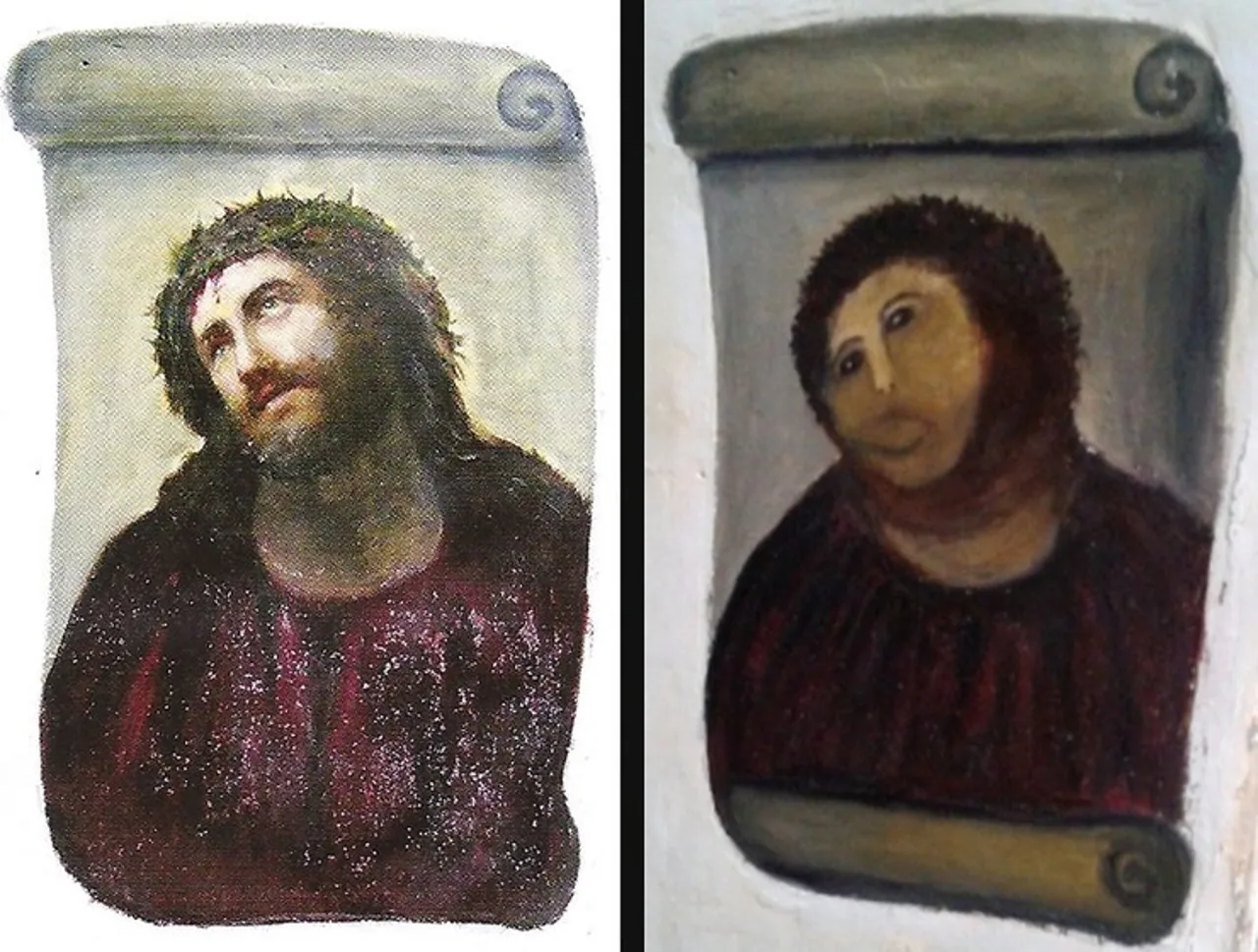
A meme is, in theories of cultural diffusion, the theoretical unit of cultural information that can be passed from one individual to another, from one mind to another, or from one generation to the next. The word is a neologism coined by Richard Dawkins in The Selfish Gene, for its phonetic resemblance to "gene" and to point to its similarity with "memory" and "mimesis."
Playful and bizarre
Memes are born on the internet out of the playful spirit of users. They carry enough iconicity to hold the most varied messages. They are the canvas on which users unload their psyche to pass it on to others and, ideally, make it go viral.
In forums, blogs or comments on news sites, memes add a different note, a touch of humor, irony or madness, either alongside the written text or as the whole message.
Given certain traits, an image can become the virtual clay of the creativity of thousands and thousands of users.
The Ecce Homo case illustrates it well: from animated gifs to elaborate jokes, the image became the mild version of internet humor. According to Dawkins, some of the traits that make any image a potential meme are longevity, fecundity and copying fidelity. But they also need a dose of the bizarre that makes them icons of a modern form of expression closely tied to the internet.
Remix culture
The creativity did not stop there. Almost as soon as the news appeared, a fan club for the restorer showed up on Facebook, and some programmer built The Cecilia Prize, a site where any user can compose their own work on top of the restored painting, or destroy the original, repeating the process that gave rise to the painting/meme. The winning "painting" earns a reproduction of Cecilia Giménez's Ecce Homo.
Memes, carriers of the social creativity of our time. Ecce Homo, the viral victim of the day.